
HVAC System Not Working? How the Fluke 116 Helps Diagnose the Fault
When an HVAC system stops heating or cooling, replacing parts based on assumptions can waste time and increase repair costs. The fault could be in the thermostat, control circuit, capacitor, flame sensor, motor, compressor or power supply.
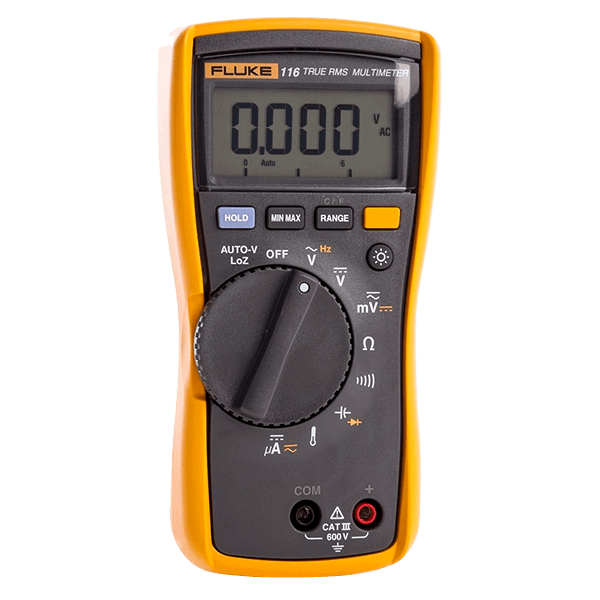
A structured diagnostic process helps technicians identify where the problem starts. Designed specifically for HVAC professionals, the Fluke 116/323 Digital HVAC Multimeter Kit combines electrical, temperature and current-measurement capabilities for troubleshooting heating and cooling equipment.
Here is how these tools can help technicians move from the initial complaint to a more informed repair decision.
1. Confirm the incoming power
Start by confirming whether the HVAC equipment is receiving the correct supply voltage. A unit that appears completely unresponsive may have a tripped breaker, damaged disconnect, loose connection or another supply-side problem.
The Fluke 116 can measure AC and DC voltage, allowing technicians to compare readings at different points in the system. This helps determine whether the fault is upstream of the equipment or within the HVAC unit itself.
The meter also features LoZ, or low-input-impedance mode. This helps reduce false readings caused by ghost voltage, which can otherwise make an inactive conductor appear energised.
Always follow the equipment manufacturer’s procedures and applicable electrical safety requirements when testing live circuits.
2. Check the thermostat and control circuit
If the correct supply voltage is present, the next step is to find out whether the system is receiving a call for heating or cooling.
Testing voltage through the thermostat and control circuit can reveal where the signal stops. Depending on the equipment, technicians may need to check the thermostat terminals, transformer, relays, contactors, switches and control-board connections.
The Fluke 116 measures voltage, resistance and continuity, helping technicians determine whether:
- The thermostat is sending the expected signal
- A fuse or conductor has lost continuity
- A switch or relay is opening and closing correctly
- A control voltage is reaching the intended component
Following the signal through the circuit makes it easier to isolate the fault without replacing working parts unnecessarily.
3. Test capacitors before replacing motors or compressors
A weak or failed capacitor can prevent a fan motor or compressor from starting correctly. It may also cause hard starting, intermittent operation, humming or repeated shutdowns.
Because the Fluke 116 measures capacitance, technicians can test a capacitor and compare the result with the rated value printed on the component. This provides more useful evidence than relying only on its physical appearance.
Capacitors can retain dangerous electrical energy after power has been disconnected. They must be isolated, discharged and tested according to the manufacturer’s instructions and established safety procedures.
4. Check flame sensors in heating systems
In gas-fired heating equipment, a contaminated or failing flame sensor can cause the burner to ignite and then shut down shortly afterwards.
The Fluke 116 measures microamps, allowing qualified technicians to check the flame-sensor current and compare it with the equipment manufacturer’s specified range. A low or unstable reading can help identify problems involving the sensor, wiring, grounding or flame-rectification circuit.
This HVAC-specific function makes the Fluke 116 particularly useful for technicians who service both heating and cooling systems.
5. Compare temperature readings
Electrical readings are only part of the diagnosis. Temperature measurements help technicians confirm whether the system is delivering the expected heating or cooling performance.
The Fluke 116 has a built-in thermometer with a stated measurement range of -40°C to 400°C. Technicians can use it to check temperatures at appropriate points and evaluate the difference between return and supply air.
An unexpected temperature difference may indicate an issue involving airflow, refrigeration performance, heat transfer or system operation. The reading should always be assessed against the equipment specifications and operating conditions rather than treated as a diagnosis on its own.
6. Assess motors and compressors
When a blower motor, condenser fan or compressor does not start, first determine whether the component is receiving the correct voltage and whether its associated control circuit is operating.
The Fluke 116 can be used for voltage, continuity, resistance and capacitance checks. For current measurement, the Fluke 323 True RMS Clamp Meter included in the kit allows technicians to measure AC current without disconnecting the conductor.
Using both instruments can help answer two important questions:
- Is the component receiving the electrical input it needs?
- Is it drawing the expected current while operating?
These checks can help distinguish between a supply or control problem and a fault involving the component itself. Learn more about using the two instruments together in Chomar Uni-Trade’s guide to the Fluke 116/323 HVAC Combo Kit.
7. Look for intermittent problems
Not every HVAC fault appears while the technician is watching. Some problems occur only during startup, under load or after the equipment has been operating for a period.
The Fluke 116’s Min/Max/Average function can record signal fluctuations during testing. This may help technicians identify voltage changes or other intermittent conditions that would be easy to miss with a single reading.
Its backlit display is also useful when working in plant rooms, roof spaces and other poorly lit areas.
A practical tool for maintenance as well as repairs
The Fluke 116 is not limited to emergency troubleshooting. Technicians can also use electrical and temperature measurements during preventive maintenance to identify unusual readings before they result in a breakdown.
Recording and comparing measurements over time can help reveal deteriorating capacitors, unstable control signals, temperature changes or other developing problems. This can support better maintenance decisions and reduce unnecessary callbacks.
Diagnose HVAC faults with greater confidence
Effective HVAC troubleshooting depends on following the fault logically and verifying each step with reliable measurements.
The Fluke 116 brings together voltage, resistance, continuity, frequency, capacitance, microamp and temperature measurement in a compact instrument designed for HVAC work. When paired with the Fluke 323 Clamp Meter, technicians can also check the current drawn by motors, compressors and other equipment.
Ready to upgrade your HVAC diagnostic toolkit? View the Fluke 116/323 Digital HVAC Multimeter Kit or contact Chomar Uni-Trade for product assistance, availability and technical guidance.