Why Solar Panels Underperform and How the Fluke IRR1-SOL Helps Find the Cause
Solar panels can produce less power than expected because of low irradiance, shading, high module temperature, incorrect positioning, changing site conditions or an electrical issue within the photovoltaic system.
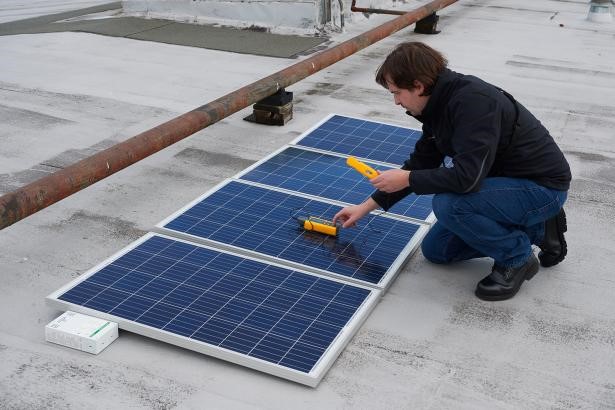
Power output alone does not always show what is causing the problem. Technicians also need to understand the conditions surrounding the panels when the measurement is taken. The Fluke FLK-IRR1-SOL Solar Irradiance Meter measures solar irradiance, ambient and module temperature, panel inclination and cardinal direction, giving technicians useful information for evaluating PV performance.
Start by checking the available sunlight
Solar irradiance is the amount of solar power reaching a surface, usually measured in watts per square metre (W/m²). It has a direct relationship with the amount of electricity a photovoltaic system can produce.
If irradiance is lower than expected because of cloud cover, nearby buildings, trees or other sources of shading, reduced output may not indicate a fault with the panels.
The Fluke IRR1-SOL allows technicians to measure irradiance directly at the installation site. This provides important context when comparing actual PV output with expected performance. Before assuming that the equipment is faulty, technicians can determine whether sufficient sunlight is reaching the array.
Check the panel and ambient temperature
Solar panels operate outdoors, where temperatures can change considerably throughout the day. Although strong sunlight can increase solar generation, high module temperatures can reduce a panel’s operating efficiency.
The IRR1-SOL measures both ambient temperature and PV module temperature. The module temperature can be checked by placing the meter directly against the panel or using the included external temperature probe.
Comparing these readings with irradiance and power measurements helps technicians determine whether high operating temperature may be contributing to lower output.
Verify the panel orientation and tilt
A solar panel’s direction and inclination affect how much sunlight reaches its surface. Even when a panel is working correctly, an unsuitable angle or orientation can reduce the solar energy it receives.
The Fluke IRR1-SOL includes an integrated compass and inclination sensor. These features allow technicians to confirm the array’s cardinal direction and tilt angle during site surveys, installations and maintenance inspections.
If the measured position differs from the system design, incorrect orientation or inclination may be one of the reasons for reduced performance.
Assess several conditions with one instrument
Investigating solar performance can take longer when technicians need separate tools to measure irradiance, temperature, inclination and direction.
The IRR1-SOL combines these important measurements in one portable instrument:
- Solar irradiance
- Ambient temperature
- PV module temperature
- Panel inclination
- Cardinal direction
Having these readings available from one device makes field inspections more efficient and provides a more complete view of the conditions affecting the PV system.
For broader system testing, technicians can also explore the Fluke SMFT-1000 Solar Tools Kit, which supports electrical safety tests, performance analysis and I-V curve tracing.
Use it during installation, commissioning and maintenance
The IRR1-SOL is useful for more than troubleshooting an underperforming system.
During site surveys and new installations, technicians can measure available irradiance and verify the proposed panel orientation and inclination. During commissioning, the readings can provide environmental data for assessing performance against the system’s expected output.
For routine maintenance, technicians can use the same measurements to determine whether shading, temperature or site conditions have changed since the system was installed.
Read Chomar Unitrade’s guide to photovoltaic testers for facility power monitoring for more information about commissioning, performance testing and solar panel troubleshooting.
What the IRR1-SOL can and cannot identify
The IRR1-SOL helps technicians determine whether irradiance, temperature, panel tilt or orientation could be affecting system performance. However, it does not independently identify every possible solar panel fault.
If site conditions and panel positioning are acceptable but output remains low, further electrical testing may be required. Technicians may need to check voltage, current, wiring, connectors, inverters or individual modules using suitable PV testing equipment.
For high-voltage DC measurements, the Fluke 393 FC Solar Clamp Meter is designed for solar installation and maintenance work in environments up to CAT III 1500 V DC.
Frequently asked questions
Why do solar panels sometimes produce less power than expected?
Common causes include low irradiance, shading, high module temperature, dirt or debris, unsuitable panel positioning, electrical faults and equipment degradation. Proper testing is needed to separate environmental conditions from installation or electrical problems.
What does a solar irradiance meter measure?
A solar irradiance meter measures the amount of solar power reaching a surface in watts per square metre. Technicians can use this reading when assessing whether a PV system’s output is appropriate for the available sunlight.
What measurements does the Fluke IRR1-SOL provide?
The Fluke IRR1-SOL measures solar irradiance, ambient temperature, PV module temperature, panel inclination and cardinal direction.
Can the Fluke IRR1-SOL detect electrical faults?
The IRR1-SOL primarily measures environmental conditions and panel positioning. Other instruments may be needed to test voltage, current, insulation resistance, wiring and system components.
Make your next solar inspection more informed
Reliable measurements help technicians investigate poor PV performance without relying on assumptions. The Fluke IRR1-SOL brings essential site and positioning measurements together in one handheld instrument, making it useful for solar site surveys, installation, commissioning and maintenance.
View the Fluke IRR1-SOL
Contact Our Team